
4 September 2026
They are both on the same screen. They look similar from the outside. But they work differently and they are good for different situations. Here is a plain explanation of each, and when to use one over the other.
ISBN scanning
One book at a time, very fast.
When to use it
- You are cataloguing incoming stock at a bookstore and processing books one at a time
- You are adding individual books to an existing catalogue
- Your books all have readable barcodes
- You want the most reliable match - barcode scanning is more precise than spine reading because it goes directly to the exact ISBN
AI shelf scanning
One photo, whole shelf.
When to use it
- You are doing a full library inventory and need to move through shelves quickly
- Your books do not have accessible barcodes - older stock, foreign-language books, books published before the 1970s
- Barcodes are present but facing the wrong way or not easily accessible without pulling each book off the shelf
- You need speed over precision - shelf scanning is faster for large volumes even though barcode scanning produces a more direct match
ISBN scanning: one book at a time, very fast
Every book published in the last fifty years or so has an ISBN - a 13-digit number encoded as a barcode on the back cover.
When you use TitleEntry's barcode scanner, you point your phone at that barcode. The app reads the number, queries book databases, and returns the matching book - cover, title, author, publisher, year, genre. All of it fills in automatically. You did not type anything.
The whole process for one book takes a few seconds. Move to the next book, scan again. You can scan as many individual books as you need.
AI shelf scanning: one photo, whole shelf
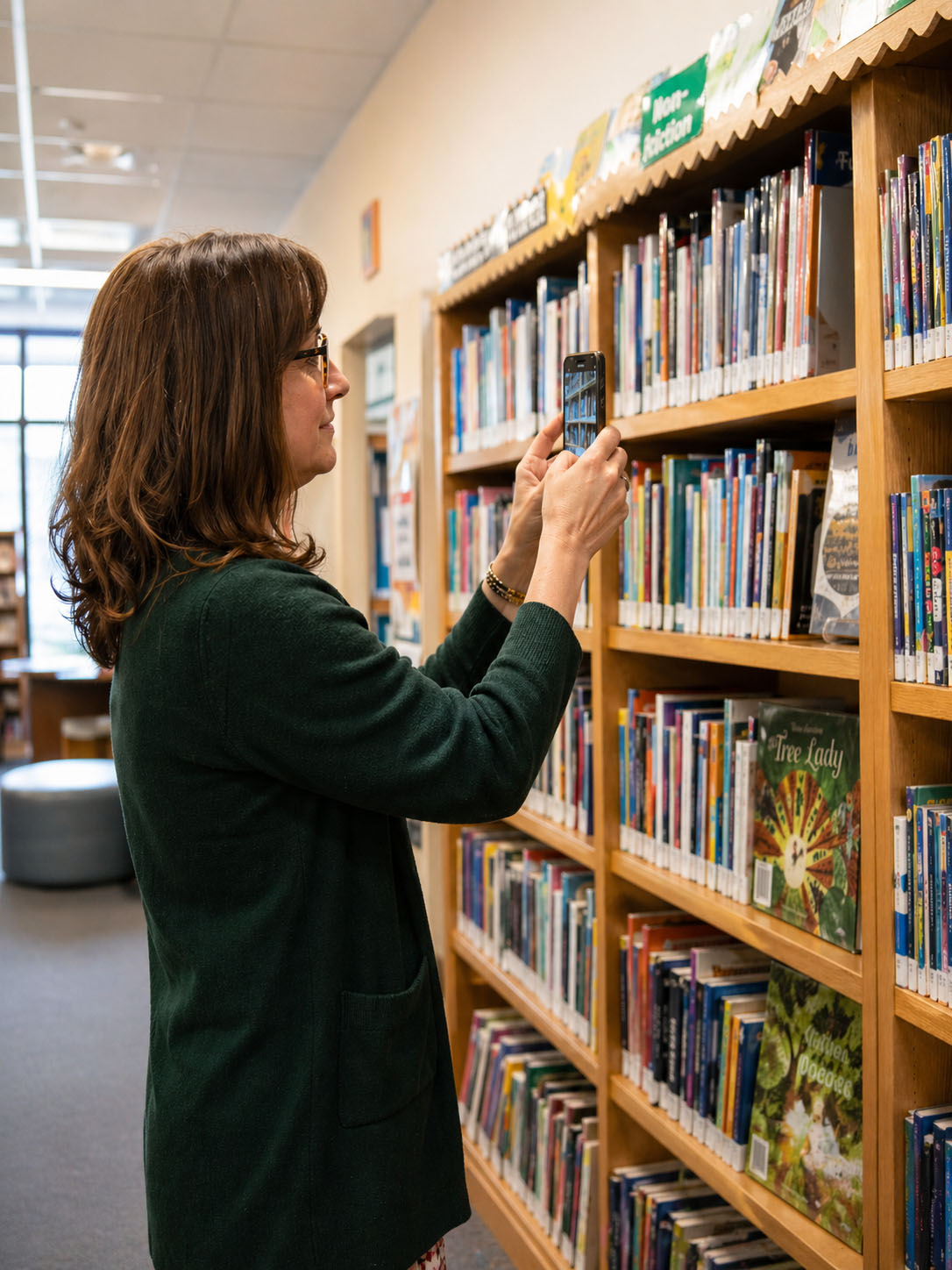
The AI shelf scan does something different. You take a photo of an entire shelf - 20, 50, 100 books at once - and TitleEntry reads the spine text on every visible book to identify them.
It looks at the title and author printed on each spine, matches that against book databases, and returns a list of all the books it found. You review the list, edit anything that needs correcting, and export. One photo can cover an entire shelf, so it is a fast way to work through a large collection.
Most people use both: barcode scanning for incoming stock, AI shelf scanning for a full inventory.
The short answer on which to use
If your books have readable barcodes and you are processing them one at a time, use the ISBN scanner. It is faster per book and more reliable.
If you need to cover a lot of shelves quickly, or your books have no readable barcodes, use the AI shelf scan. In practice, most people use both - barcode scanning for incoming stock processed individually, AI shelf scanning for a full inventory of existing shelves. They work together in the same catalogue and the same export.
What if neither finds the book?
Some books are not in any database. Very old books, self-published titles, local publications, books from markets where database coverage is thin. For these, add the book manually. You enter the title, author, and any other details you have, and it saves to your catalogue alongside everything else. Nothing gets left out.
Manual entry exists for exactly this situation. It is not a scanning method in the same sense as the other two - it is what you do when scanning is not an option. A few books in any large collection will need it. It is straightforward: fill in what you know and move on.
Want to see both methods in action?
Get in touch and we will walk you through the product based on your specific collection.
Try TitleEntry